Appliance Tips
Dishwasher Water Not Hot Enough and Won't Drain Fully — Check the High Loop
Harmony Appliance Repair · Greater Vancouver
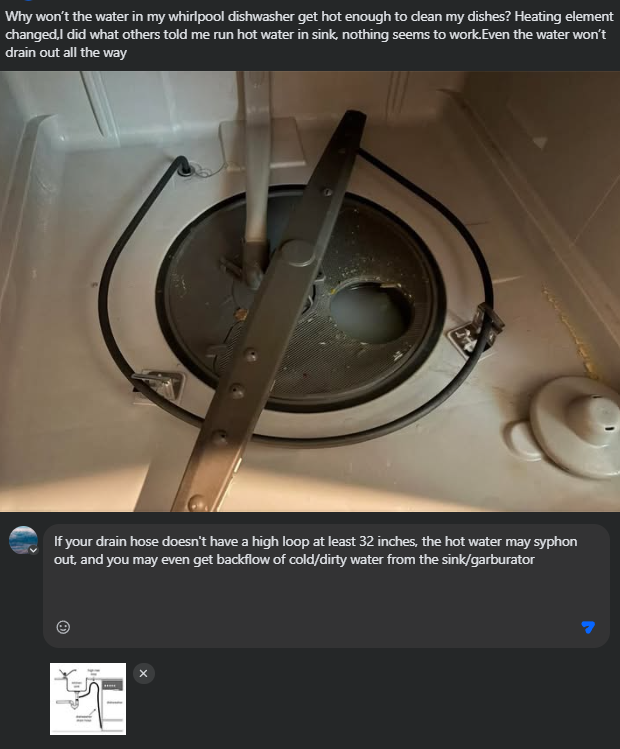
You've replaced the heating element. You run the kitchen faucet hot before every cycle. Dishes still come out cool and greasy — and there's standing, murky water in the sump when the cycle ends. On a Whirlpool (and most built-in dishwashers), that pair of symptoms often points outside the machine: the drain hose installation.
The siphon problem in plain English
The dishwasher fills, heats, and washes with a fixed volume of water in the tub. When the drain hose runs too low — flat across the floor of the cabinet, or tied straight into a disposal without a rise — two bad things can happen:
- Siphoning during the wash. Hot wash water gets pulled out toward the sink or disposal before the heater and spray jets have done their job. The tub never holds a proper hot bath, so dishes feel lukewarm even with a good element.
- Backflow after drain. Cold, dirty sink water (or disposal leftovers) can flow back into the tub. You open the door to standing water that smells like the drain, not like fresh rinse water.
A proper install keeps the hose high under the counter so gravity and a deliberate drain pump cycle — not a continuous siphon — control flow.
What "high loop" means (and the 32-inch rule of thumb)
Install the drain hose so it rises to a high loop under the countertop, typically at least 32 inches (about 81 cm) from the floor, then drops down to the disposal inlet or air gap / drain connection.
- Secure the high point with a strap or clip under the counter — don't rely on the hose "staying up" on its own.
- Many codes and manufacturers also want an air gap on the sink deck, or a connection that meets local requirements. Follow the install sheet for your model and your municipality.
- If the hose connects to a garbage disposal, knock out the disposal plug when the disposal is new, and confirm the hose isn't kinked behind the cabinet.
If your hose currently snakes along the cabinet floor into the disposal, raise it. That alone fixes a surprising number of "won't heat / won't drain clear" tickets.
How to confirm this is your issue (DIY-friendly)
Safety: Shut off power to the dishwasher (breaker or unplug) before pulling it out. Shut off the water supply if you're disconnecting the fill line. Have towels ready — leftover water will spill.
- Pull the dishwasher forward enough to see the drain hose path under the sink and along the left or right side of the cabinet.
- Trace the hose from the dishwasher out to the sink/disposal. Is there a clear upward loop to roughly countertop height? Or does it run low the whole way?
- After a cycle, look at the sump. Standing water covering the filter area with a dirty sheen is classic siphon/backflow territory — especially if the drain pump sounds like it ran.
- Optional check: temporarily raise and secure a proper high loop, restore power, run a short cycle, and compare tub temperature and how empty the sump is at the end.
Also rule out the usual drain blockers: chopped-up filter screen, food in the sump, kinked hose, or a clogged disposal inlet. A high loop won't fix a solid plug.
Heating element vs installation — don't keep replacing parts
If the element was already changed and you still get cool washes plus incomplete drain, stop chasing thermostats and control boards first. Fix the hose geometry. Only after the high loop (and any air gap) is correct should you dig into:
- Inlet water temperature (kitchen supply actually hot at the faucet)
- Turbidity / soil sensor and cycle selection
- Thermistor / NTC and heater circuit diagnostics
Standing water from backflow can also make the machine feel like the heater failed — cold dirty water keeps re-entering.
DIY vs call a tech
Reasonable DIY if you can pull the unit a few inches, route and strap the hose, and reconnect without stressing the water line or power cord.
Call a tech if:
- The cabinet is tight, hardwired, or the water line is corroded
- You're unsure about air-gap vs high-loop requirements in your area
- Raising the loop doesn't clear standing water (pump, check valve, or clogged path)
- You smell burning, see scorched wire, or get error codes after the install change
Safety notes
- Never leave a sharp kink in the hose when you raise it — that creates a new clog.
- Support the dishwasher when it's pulled out; the feet (on some installs) can shift.
- If you have an air gap that constantly overflows, that's a separate drain-path clog — don't just cap it off.
When to call a pro
If the high loop is solid and the tub still won't hold hot water or empty cleanly, a field tech can check the drain pump, check ball / flapper, hose for internal collapse, and fill/heat circuit with meters. Have the model and serial from the tub tag handy when you book.
Harmony Appliance — practical repair guidance for homeowners across BC. If you're local and stuck mid-diagnosis, we're happy to take a look.