Appliance Tips
That Little Black Rubber Oval in Your Dishwasher Bottom
Harmony Appliance Repair · Greater Vancouver
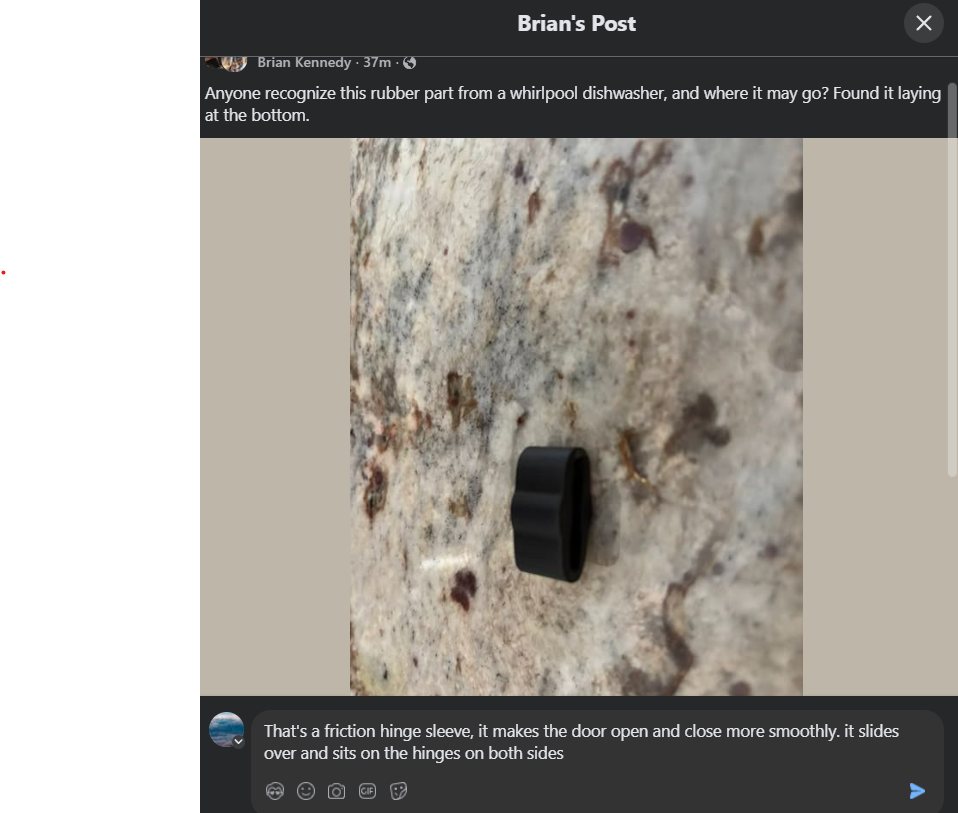
You open the dishwasher, pull out the bottom rack, and there it is: a small black rubber piece — oval, slightly pinched in the middle, almost like a tiny bow-tie — sitting in the sump or on the tub floor. It looks important. It is important. And it didn't fall out of the spray arm.
On Whirlpool-family dishwashers (Whirlpool, KitchenAid, Maytag, and many Kenmore rebadges), that part is almost always a friction hinge sleeve.
What the part is
Each door hinge has a pin. The friction hinge sleeve is a rubber (or elastomer) sleeve that slides over the hinge pin. Its job is simple: add a bit of friction and cushion so the door opens and closes more smoothly, without slamming or feeling loose and metallic.
There is typically one on each side. If you only found one on the floor, check whether the other side still has its sleeve in place.
What the symptom means
Finding the sleeve loose in the tub usually means:
- It worked its way off the hinge pin over time (common after years of open/close cycles)
- The door may now feel lighter, less damped, or slightly off on one side
- Rarely, a missing sleeve can contribute to uneven door travel — but it won't stop the machine from washing
It is not a seal for the door gasket, a pump part, or a piece of the filter. If wash performance is fine and you only found this part, you're dealing with a hinge accessory — not a catastrophic failure.
How to check / put it back
Safety: Unplug the dishwasher or shut off its breaker. Turn off the water supply if you'll be pulling the unit for better access (often not required for this part).
- Open the door fully and look at the hinge area on both sides — where the door pivots against the tub/frame.
- Compare sides. One hinge may still have its black sleeve; the other is bare.
- Take off the string that holds the spring tension — it will take some force. Don't be shy.
- Slide the sleeve back onto the bare hinge pin. Orientation is usually obvious: it sits on the pin so the door can still travel through its full arc. Don't force it onto a sharp edge that could tear it.
- Open and close the door a few times. It should feel more even and controlled.
If the rubber is cracked, flattened, or torn, replace it rather than reinstalling a spent part. Order by model number; hinge sleeves are inexpensive.
DIY vs call a tech
DIY-friendly for most homeowners who can see the hinges with the door open. No special tools beyond patience and a flashlight.
Call a tech if:
- The door still droops, binds, or won't stay open after both sleeves are in place (springs, cables, or hinge brackets may be worn)
- You can't access the hinges because of a custom panel or tight install
- The door gasket is leaking at the same time — that is a separate issue
Safety notes
- Support the door when working near hinges; a heavy stainless door can pinch fingers.
- Don't overtighten hinge fasteners if you remove panels — stripped captive nuts are a nuisance.
- If you pull the dishwasher out for access, mind the water line and drain hose; kinks cause new problems.
When to call a pro
A missing hinge sleeve alone rarely justifies a service call — but if the door slam is damaging dishes, the springs feel broken, or you're also fighting leaks and poor wash results, book a visit. We'll sort hinge hardware from sump and spray issues in one go.
Harmony Appliance — clear answers, correct parts, no scare tactics.